
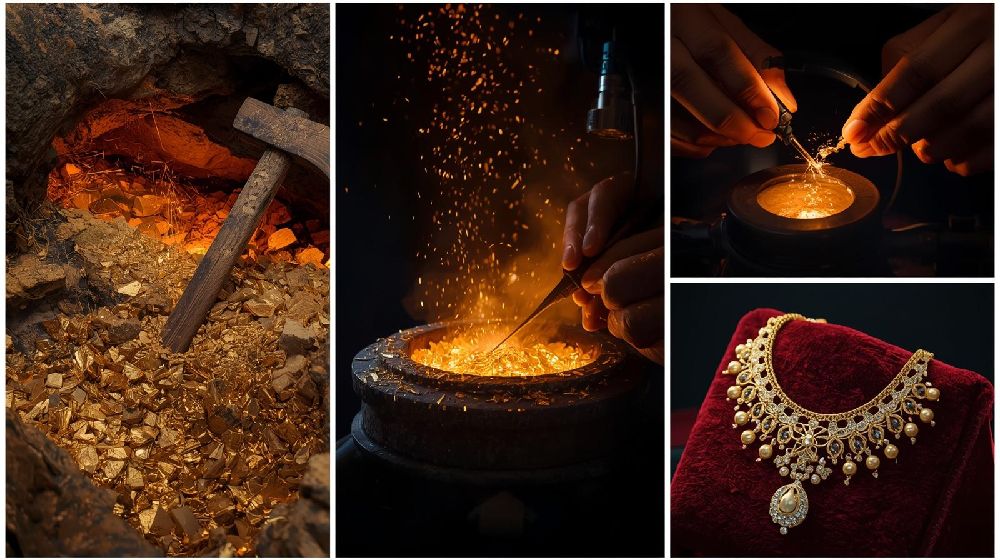
How gold transforms from hidden earth to heirloom elegance
Gold has always symbolized beauty, purity, and wealth—but few people truly know the intricate journey it takes before becoming the jewelry we wear and treasure. From mining deep within the earth to the final polishing at a jeweler’s bench, every step is a blend of science, craftsmanship, and technology.
Let’s walk through the complete journey of gold—from raw metal to a stunning finished piece of jewelry.
1. Mining: Where the Story Begins
The journey starts far below the earth’s surface.
How Gold Is Extracted
-
Gold is mined from rock deposits or extracted from river sediments.
-
Modern mining uses machinery to crush rock and separate gold from other elements.
-
Once collected, raw gold appears dull, mixed with impurities.
Why Mining Is Important
It provides the base material—pure gold—which will later be refined, shaped, and crafted.
2. Refining: Purifying the Precious Metal
Gold in its natural form is rarely pure. Refining removes impurities like silver, copper, and other metals.
Common Refining Techniques
-
Electrolytic refining
-
Miller process
-
Cupellation
The Goal
To achieve 99.9% pure gold (24K)—the standard used before alloying for jewelry creation.
3. Alloying: Creating the Perfect Karat
Pure 24K gold is too soft for everyday wear. That’s why jewelers blend it with other metals to create durable gold alloys.
Why Alloying Is Done
-
Strengthens the gold
-
Changes the color (yellow, white, rose)
-
Enhances durability
Examples
-
22K – high purity, ideal for traditional jewelry
-
18K & 14K – strong, durable, ideal for modern wear
-
White gold – mixed with nickel, palladium, or silver
-
Rose gold – mixed with copper
4. Designing: From Concept to Creation
Before manufacturing begins, designers visualize the jewelry piece.
Design Stages
-
Sketching: Hand-drawn ideas
-
CAD Modeling: 3D digital design using software
-
Prototyping: 3D printed or wax prototype for accuracy
This step ensures the final piece has perfect proportions, balance, and aesthetics.
5. Manufacturing: Bringing the Design to Life
Modern jewelry manufacturing uses a blend of technology and handcrafting. Some key techniques include:
a. Casting
-
Wax models are created, molded, and filled with molten gold.
-
Perfect for rings, pendants, and bangles.
b. CNC (Computer Numerical Control)
-
Machines mill gold with precision to create flawless patterns.
-
Best for bangles, kadas, and symmetrical designs.
c. Laser Cutting & Engraving
-
Creates ultra-fine patterns, names, and texture work.
-
Ensures clean finishing and accuracy.
d. Handmade Craftsmanship
-
Artisans handle stone setting, soldering, polishing, filigree, and engraving.
-
Adds human emotion and detail to every piece.
6. Stone Setting: Adding Sparkle & Soul
If the design includes diamonds, gemstones, or CZ stones, they are carefully set using techniques such as:
-
Prong setting
-
Bezel setting
-
Miracle setting
-
Pave setting
-
Micro setting
Each stone is placed with precision to ensure brilliance and secure hold.
7. Polishing & Finishing: The Final Touch
This is where the jewelry transforms into its final glamorous form.
Finishing Includes
-
Multiple rounds of polishing
-
Ultrasonic cleaning
-
Buffing for smooth surfaces
-
Applying textures or matte finish
-
Quality inspection
The piece is checked for weight, shine, symmetry, durability, and comfort.
8. Quality Check & Hallmarking
Before reaching the customer, each piece undergoes:
-
Strength tests
-
Purity verification
-
Karat certification
-
Hallmarking based on BIS standards
This ensures the jewelry is authentic, safe, and long-lasting.
Conclusion: A Journey of Transformation
From an unrefined mineral hidden deep in the earth to a polished masterpiece in your jewelry box, gold undergoes a remarkable transformation. It passes through the hands of miners, refiners, designers, craftsmen, and quality experts—each adding value, skill, and beauty.
The result?
A timeless piece of jewelry that carries history, craftsmanship, and emotional meaning.